Temperature & Enthalpy: What’s Really Happening Beneath the Surface
In hydrocarbon extraction, temperature gets all the attention. But ENTHALPY is the foundational thermodynamic property that makes refrigeration possible. Operators talk about how large their chiller is, or the low temp that can be achieved. Entire purchasing decisions are often made around temperature numbers alone.
But temperature is really a small part of the story.
The real workload happening inside an extraction system is something much larger and far more important. It’s called enthalpy.
And understanding the difference between temperature control and enthalpy management is one of the clearest ways to understand why traditional chiller-based systems operate fundamentally differently than ProJak™ DX refrigeration.
Temperature: Readable Results. Enthalpy: Work Being Done.
Most operators think of refrigeration in terms of “getting cold.” But extraction systems are not simply cooling objects, they are constantly moving heat energy through phase changes. Liquid hydrocarbons become vapor. Vapor condenses back into liquid. Columns absorb heat. Solvents reject heat. Energy is constantly entering and leaving the system. This movement of total heat energy is enthalpy.
Temperature is the number you read on the gauge or screen.
Enthalpy is the amount of work the system is actually performing.
That distinction matters because traditional chiller systems and ProJak™ DX refrigeration approach that workload in completely different ways.
Traditional Chillers Chase Temperature
Most extraction systems on the market rely on external chillers and heaters to indirectly manage process temperatures.
The workflow typically looks like this:
- A chiller cools a fluid reservoir
- That fluid circulates through jackets or external loops
- The system attempts to transfer enough heat away from the process to maintain target temperature
At a small scale, this can work reasonably well.
But as throughput increases, the enthalpy load increases dramatically. More solvent cycling means more vapor generation, more condensation demand, and more heat energy moving through the process.
That’s where many systems begin to struggle.
Operators often compensate by installing:
- Larger chillers
- Larger heaters
- Larger reservoirs
- More ancillary equipment
But larger thermal support systems do not necessarily mean greater efficiency. They simply mean the system is consuming more infrastructure in an attempt to keep up with the growing enthalpy demand. The chiller is constantly reacting to heat loads after they occur instead of actively controlling the phase-change process itself. That’s a reactive architecture.
ProJak™ DX is Enthalpy Centric
ProJak™ DX refrigeration approaches the problem differently from the beginning. Instead of relying on large external thermal reservoirs, ProJak directly manages the refrigerant and solvent phase-change process inside the system itself. That’s an important distinction.
Rather than indirectly cooling a process through external loops, ProJak™ DX refrigeration is engineered to actively move heat energy at the process level, where the enthalpy load is actually being generated.
This allows the system to:
- Heat and chill columns on demand
- Respond rapidly to changing thermal loads
- Manage solvent phase changes more efficiently
- Reduce dependence on oversized external infrastructure
The result is not simply a colder operation. In reality it’s smarter energy transfer.
Why Phase Change Matters More Than Setpoint
One of the biggest misconceptions in extraction is that colder automatically means better.
The challenge isn’t reaching temperature, it’s maintaining efficient energy transfer while the system is actively processing solvent.
During solvent recovery, hydrocarbons continuously transition between liquid and vapor states. That phase change carries significant latent heat energy. Removing that energy efficiently is what determines how quickly solvent can condense and cycle back into production.
Traditional chiller systems often struggle because they are attempting to manage this enthalpy load indirectly through secondary fluid systems.
ProJak™ DX refrigeration addresses the problem directly.
Instead of waiting for external thermal loops to absorb and reject heat, the system actively manages refrigerant compression and phase change internally. That direct approach dramatically improves responsiveness and reduces thermal lag throughout the process.
In simple terms:
Traditional systems wait for heat transfer to happen. ProJak™ DX ACTIVELY drives it.
The Overlooked Problem
Most operators only see the visible side of refrigeration. The temperature reading, the chiller size, the cooling capacity.
But beneath the surface lies the real workload:
- Solvent vaporization
- Vapor condensation
- Recovery rates
- Thermal cycling
- Energy transfer efficiency
That hidden workload is the enthalpy demand of the system.
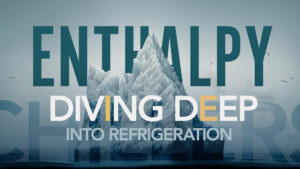
And just like an iceberg, the largest and most important part is happening below the surface. A larger chiller may improve visible cooling capacity, but if the system architecture itself is inefficient at managing enthalpy, the bottlenecks remain.
That’s why many labs eventually find themselves trapped in a cycle of adding larger and larger thermal support systems just to maintain operational consistency. It’s not a viable way to scale.
Efficiency Is About Energy Movement, Not Equipment Size
The extraction industry has spent years equating larger chillers with higher performance. But true efficiency isn’t determined by the size of the thermal support equipment. It’s determined by how effectively the system moves heat energy through the process.
That’s where ProJak™ DX fundamentally separates itself.
By focusing on direct refrigeration, active compression, and process-level thermal management, ProJak reduces dependency on oversized ancillary systems while maintaining the flexibility to process multiple product types efficiently. Instead of building an operation around heaters and chillers, the refrigeration becomes integrated into the process itself.
That shift changes everything.
Energy Management
At the end of the day, the conversation isn’t really about how cold a system gets.
It’s about how intelligently it manages energy.
Traditional chillers chase temperature numbers while reacting to growing thermal loads. ProJak™ DX refrigeration was engineered to manage the enthalpy behind those loads directly: controlling phase change, improving energy transfer, and reducing dependency on massive external infrastructure. Because in extraction, temperature is only the surface-level metric.
The real performance happens underneath.