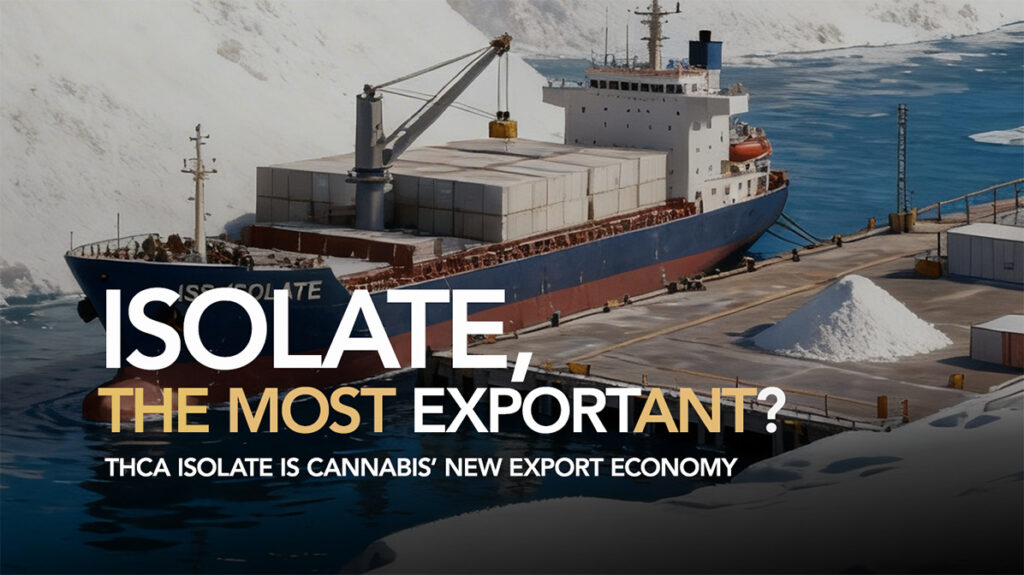
Isolate, the most EXPORT-ANT?
For much of the past decade, cannabis extraction has revolved around familiar products: live resin, shatter, wax, and distillate. These products helped define the modern concentrate market and drove the rapid growth of extraction technology across North America.
But the industry is changing.
A new class of product is emerging as one of the most important outputs of modern cannabis processing: THCa isolate. What began as a niche concentrate for experienced consumers is quickly becoming something much bigger, a standardized cannabinoid ingredient with global market potential.
As regulatory frameworks evolve and international markets open, THCa isolate is poised to play a central role in the next phase of cannabis manufacturing.
From Specialty Product to Standardized Ingredient
THCa isolate represents one of the purest cannabinoid products currently achievable through hydrocarbon extraction and crystallization. Through controlled nucleation and crystallization processes, processors can produce high-purity THCa crystals that serve as both a consumer product and a foundational manufacturing ingredient.
What makes THCa isolate unique is its versatility.
Unlike many cannabis products that are tied to a specific form factor or consumer preference, THCa isolate can function as:
- A finished consumer product
- A blending component for infused goods
- A precision ingredient for cannabinoid formulations
- A pharmaceutical precursor for standardized dosing
Because of this flexibility, isolate production is increasingly becoming a strategic priority for extraction labs looking to position themselves for the future of the industry.
The Globalization of Cannabis Processing
The cannabis market is no longer confined to state borders or domestic markets.
In recent years, Canada has begun exporting cannabis-derived products to Europe, where medical cannabis programs continue to expand and regulatory frameworks are becoming more defined. European markets, particularly Germany, are demanding pharmaceutical-grade cannabinoid inputs that meet strict production standards.
Isolates naturally fit this requirement.
Their high purity, consistency, and reproducibility make them easier to validate, standardize, and incorporate into regulated manufacturing environments compared to many traditional cannabis concentrates.
As international cannabis trade continues to evolve, standardized cannabinoids like THCa isolate will likely become one of the most practical products to move across borders.
Rescheduling Brings the Industry One Step Closer
In the United States, the anticipated rescheduling of cannabis from Schedule I to Schedule III represents a major turning point for the industry.
While rescheduling does not immediately legalize interstate cannabis commerce, it signals a meaningful shift in federal policy and regulatory posture. Over time, this shift is expected to:
- Improve access to capital and traditional banking
- Encourage broader institutional investment
- Create momentum toward state-to-state commerce frameworks
When interstate trade eventually becomes viable, the cannabis industry will face a new economic reality: commoditization of cannabinoids.
At that point, extraction labs may no longer compete solely within state boundaries, they may compete across regions, production efficiencies, and manufacturing capabilities.
This is where THCa isolate becomes especially important.
Why THCa Isolate Is Positioned for Commodity Status
Commodity markets require three things: standardization, scalability, and repeatability.
THCa isolate checks all three boxes.
Unlike terpene-rich concentrates that vary significantly from batch to batch, isolate production allows manufacturers to achieve consistent cannabinoid purity and predictable outcomes. That consistency makes it far easier to price, transport, formulate, and regulate.
In many ways, THCa isolate could become to cannabis what ethanol is to spirits production or pharmaceutical APIs are to medicine manufacturing… a standardized input that fuels a wide range of downstream products.
For extraction labs, this represents both an opportunity and a challenge. Producing isolate efficiently requires systems capable of processing large volumes of biomass while maintaining tight process control. Labs that invest early in scalable and efficient infrastructure will be better positioned to supply the growing demand for purified cannabinoids
Scaling for the Next Phase of the Industry
As cannabis transitions from a fragmented state-by-state market into a broader national and international industry, manufacturing priorities are shifting.
Operators are beginning to look beyond boutique concentrates and focus on industrial-scale cannabinoid production. Facilities that can produce isolates efficiently, while maintaining compliance, consistency, and throughput, will play a key role in the future supply chain.
The ability to process more material, reduce operational inefficiencies, and eliminate unnecessary complexity will become increasingly valuable as markets mature and margins tighten.
In other words, the next chapter of cannabis processing will look much more like modern chemical manufacturing than the early craft phase of the industry.
The Road Ahead
The cannabis industry has always been defined by rapid evolution. Products that once dominated the market have quickly given way to new formats, new technologies, and new expectations.
THCa isolate represents the next stage of that progression.
As international markets expand, regulatory frameworks develop, and interstate commerce moves closer to reality, the demand for high-purity, standardized cannabinoids will continue to grow.
For processors and manufacturers willing to adapt, isolate production offers a glimpse of where the industry is headed: toward scale, consistency, and global cannabinoid supply chains.
And when that shift arrives, the facilities capable of producing THCa isolate efficiently will be the ones leading the next wave of cannabis manufacturing.